
The role of the actuary is rapidly evolving in response to the growing challenges posed by climate change. As climate-related events become more frequent and more severe in Canada and the world, actuaries are increasingly called upon to lead in assessing the emerging risks – and opportunities – that arise. In 2024 alone, Canada experienced approximately $8.5 billion in insured losses from natural catastrophes, with impacts ranging from flooded basements and vehicle damage to destroyed homes, temporary evacuations and, tragically, loss of life.
How can actuaries leverage their expertise to improve the understanding and forecasting of climate-related events?
Climate risk modelling is inherently complex and demands a multidisciplinary approach to fully capture its multifaceted impacts.
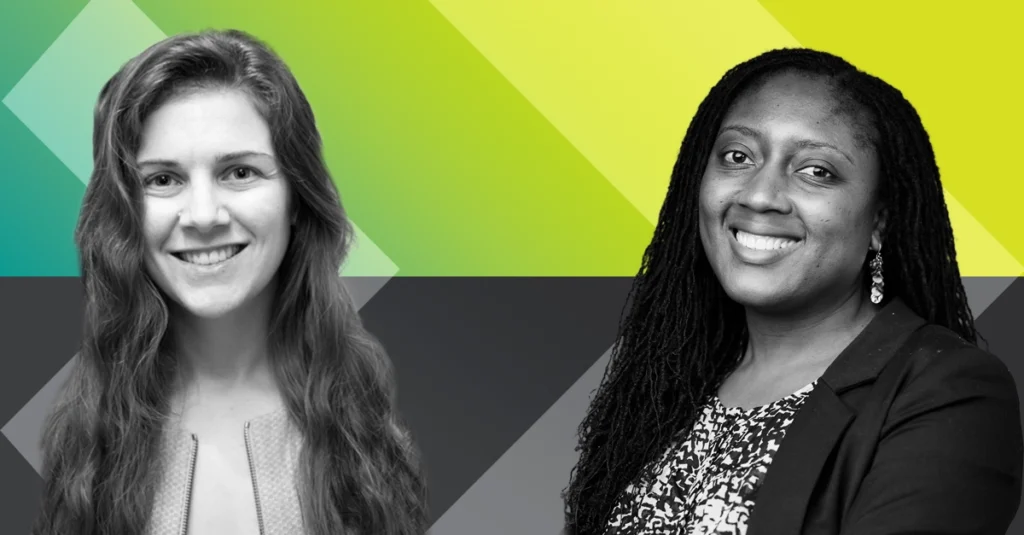
In this article, we explore a unique collaboration between two actuaries – a life actuary and a property and casualty (P&C) actuary – who have traditionally operated in separate spheres but have joined forces to tackle climate risk modelling.
You’ll learn how this partnership, working alongside climate scientists, combines distinct skill sets and insights to reimagine climate risk not just as a challenge to mitigate but as an opportunity to innovate. This shift is more than technical; it represents a fundamental change in mindset. Let’s break down silos – and build a more resilient future together.
1) Can you tell us about your background and your disciplines?
Cassandra: Of course. I am a life actuary, specifically a Fellow of the Canadian Institute of Actuaries (FCIA), Fellow of the Society of Actuaries (FSA) and a Chartered Enterprise Risk Analyst (CERA), and my work experience started as traditional life actuarial work, such as valuation, pricing and asset-liability management. About seven years ago, I started getting more exposure to the risk-management side of actuarial science, including being a chief risk officer (CRO) of a life and P&C insurer. Now I work at PwC in our financial-services risk and regulatory (FSR&R) area, where I focus on insurance risk and climate risk modelling.
Gloria: I’m the P&C actuary in this picture. I am an FCIA, a Fellow of the Casualty Actuarial Society (FCAS) and a member of the American Academy of Actuaries (MAAA). I started out my career in the U.S. doing commercial-lines pricing for a large global insurer that has a wide offering of both traditional and specialty lines of business. I relocated to Canada almost 10 years ago, and eventually headed up the actuarial pricing team and served on the leadership team for the Canadian branch of the entity. Since joining the FSR&R team at PwC, I’m one of the leaders of our team of approximately 40 P&C actuaries and we help our personal-lines and commercial-lines clients with a wide range of needs – from various pricing, Appointed Actuary and audit services to advisory support on Office of the Superintendent of Financial Institutions (OSFI) regulations and climate and exposure management.
2) How did the life and P&C teams come together to collaborate on climate risk modelling?
Gloria: Cassandra and I started at PwC within a few weeks of one another, and while we were trying to navigate a new experience, we came to the realization that we both had a significant amount of interest in climate risk modelling.
Cassandra: I was peppering Gloria with questions because, as a life actuary, I had little climate exposure and only knew it from a regulatory-requirements perspective from my time as a CRO. Slowly, we realized that the challenge with climate risk modelling is that it requires both disciplines to properly model transition climate risk and physical climate risk. If we’re modelling risks in isolation, we’re only telling half the story. To truly understand and quantify climate risk, we needed to collaborate.
Gloria: Exactly. And we were in a unique situation in industry where both life and P&C actuaries worked under the same leadership. Due to the large property portfolios we write, climate change has been on the P&C radar for decades. The industry has done a lot to draw attention to governments, insurance holders and society at large about the risks of climate change. My team could therefore bring to the table our knowledge regarding CAT (catastrophe) modelling, short-term volatility and implications for the P&C insurance industry. In my conversations with Cassandra, though, she shared a lot about long-term modelling and transition risk in assets, which made it clear we could leverage a lot of the life actuary’s knowledge. She also confirmed that deep thinking on climate was somewhat newer on the life insurance side, and that numerous implications exist around it.
Cassandra: A lot of climate risk modelling mirrors the foundational knowledge from the life insurance world. We understand how to consider seemingly unpredictable events from our work modelling mortality while balancing lifestyle changes, infectious diseases and medical advancements. We also regularly use economic-scenario generation and stochastic-on-stochastic modelling. For long-term climate modelling, the difference isn’t necessarily the modelling techniques but the underlying data used and the variables and interaction between variables.
3) What other disciplines do you need for climate risk modelling?
Gloria: Great question! Cass and I make a great team but there is a nuance in what we do. Climate scientists really understand the details around the Earth’s entire climate system, specialize in processing huge amounts of climate data to assess climate indicators over the long term, and appreciate the difference between weather and climate. Thus leveraging the modelling performed by climate scientists is the first step in the data process that we can then feed into our actuarial disciplines for comprehensive, long-term climate risk modelling.
Cassandra: When you start to model climate events beyond five to 10 years, you are factoring in climate change. That is an entire discipline on its own, and it’s not actuarial. Gloria and I work closely with a large team of climate scientists with a variety of backgrounds in order to understand how climate change impacts various factors. We then use their modelling as a foundation to develop our short- and long-term assumptions. We can then begin to build the climate model. The true collaboration is between life actuaries, P&C actuaries and climate scientists.
Gloria: Agreed. And such collaboration is not entirely new to P&C actuaries either. Similar collaboration happens between actuaries, meteorologists, engineers and other disciplines in CAT model development.
4) What challenges have you encountered when trying to integrate two actuarial disciplines into a unified climate risk approach?
Gloria: Cassandra and I have spoken at length on this, drawing an analogy to a language barrier. There is climate-science language, P&C language and life language. They all have some similarities and some differences, and bridging that gap takes effort, adaptability, and often trial and error. However, the effort to push through this barrier is worthwhile, especially in envisioning the beautiful story we can create together in the innovation we deliver. When we put aside our academic backgrounds and just have a brainstorm focused on the task at hand, it’s a fantastic collaboration.

5) From your experience, how are companies currently approaching climate risk modelling? Are there differences in how large versus small insurers respond?
Cassandra: It’s been a bit slow, given that insurers are still recovering from IFRS 17 implementation. I would say that most insurers that have started climate risk modelling are doing so in a targeted or narrow-focussed way. They aren’t taking a step back and doing a fulsome risk assessment across all areas of their business to see where climate risk exists. They instead jump into modelling based on their own gut feel of where the risk lies. What can happen in that situation is that resources aren’t allocated in an effective way and too much time is spent on modelling that may not produce useful results. Laying the foundation for proper climate risk modelling involves understanding where you actually need to spend time and effort to do it. That’s how you can then make prudent, long-term strategic decisions and gain competitive advantage by using meaningful climate risk modelling results.
Gloria: I can get into the specifics a bit. Insurers are increasingly integrating climate-specific scenario analysis, particularly in response to regulatory expectations such as OSFI’s B-15 climate risk management guideline. Larger insurers seeking to be leaders in the space are putting their larger teams to adopt sophisticated techniques and collaborating with climate scientists to assess complex risks like the implications of sea-level rise, wildfire spread and extreme heat. They are also aligning their investment strategies with long-term decarbonization goals. In contrast, smaller insurers often face resource limitations and tend to rely on standardized tools or software licenses, for their modelling needs. Their priority is typically on shorter-term, high-impact CAT events, as they may find it more challenging to model and prepare for long-term climate scenarios.
6) What do you envision for the next three to five years when it comes to climate risk modelling in insurance? How will the actuarial profession evolve in this space?
Gloria: In the next three to five years, climate risk modelling will become more integrated, cross-functional and data-driven. We’ll see convergence across functions, shared platforms and broader use of granular data, from intra-annual mortality models to AI-driven climate analytics. Will that be the time that we shift toward more parametric products? Possibly, depending on the industry CAT losses we see over that period. I do feel more confident that we’ll see the introduction of some innovative nature-based solutions to address protection gaps in high-risk areas.
Cassandra: The actuarial profession will evolve to include climate science, enabling actuaries to lead multidisciplinary teams and align underwriting, capital and investment strategies with net-zero goals. As the CIA and other bodies advance research in this space, actuaries will increasingly move from technical contributors to strategic advisors, helping insurers embed climate resilience into their core business and long-term planning. At PwC, we support this transformation by integrating climate insights into capital modelling, governance and long-term strategy.
7) How do actuaries’ roles evolve with increasing involvement in climate risk and strategy?
Cassandra: We’re evolving from number crunchers to strategic thinkers. Climate risk has pushed us into boardrooms, working alongside CROs, CFOs, and environmental, social and governance committees. We’re contributing to capital planning, liquidity management and sustainability strategy: all things that drive real business impact. In fact, many of us working in risk are still considered to be in “non-traditional” actuarial roles,” but these should be part of the modern actuarial identity. We’re translating data into decisions – forecasting not just what could happen, but helping organizations understand what actions to take.
8) How can actuaries lead or influence strategic decision-making in the future of insurance, and what is the CIA’s role in this?
Gloria: The CIA has taken a proactive stance in elevating climate risk on the actuarial agenda. Through Institute publications such as policy statements and insight statements, along with efforts like this article, practice resources and ongoing education, the CIA is doing a lot to help actuaries to expand their toolkit and shape the changing landscape. As practicing actuaries, we too should do our part to volunteer and engage in this new area. Recognizing that education never stops and that the Institute can’t do everything, we should assert ourselves as leaders in this space to make the positive impact on society that we are trained to do.
Cassandra: Yes. We can lead the narrative by being bold and stepping outside our comfort zone. Ask “what if” and “what’s next.” Get involved in strategic decision-making. Take a non-traditional role in risk or climate. Get involved in industry committees. Actuaries are uniquely positioned to influence decisions around underwriting strategy, investment portfolios and long-term financial planning. With climate risk, we’re not just informing the business, we’re helping to future-proof it. To lead effectively, actuaries must embrace interdisciplinary roles, communicate insights clearly to non-technical stakeholders, and continuously upskill in areas like data science, scenario analysis and sustainability.
Closing thoughts
The collaboration between life and P&C actuaries – working alongside climate scientists – illustrates how breaking down traditional silos can unlock powerful insights and innovative solutions to the complex challenge of climate risk. As climate change accelerates, actuaries are stepping into expanded roles that go beyond technical modelling to strategic leadership, helping insurers and society prepare for and adapt to a rapidly shifting risk landscape. With ongoing interdisciplinary collaboration, continued learning and proactive engagement, the actuarial profession is poised to be a pivotal force in building a more resilient and sustainable future. Together, actuaries can transform climate risk from a hurdle into an opportunity for innovation and resilience.
The opinions expressed in this article are those of the interviewees, and do not represent an official statement of the CIA.